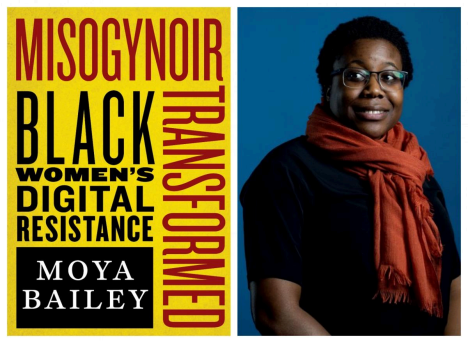
Let’s pour the tea properly…Halle Berry remains the only Black woman to win Best Actress at the Academy Awards, for her role in Monster’s Ball. That performance was layered with emotional depth, yes, but also steeped in sexual degradation unfolding opposite Billy Bob Thornton. That win was in 2001. It has been over two decades, and no other Black actress has been crowned in that category since. And let’s be clear: that kind of absence doesn’t happen by accident…it’s curated. The Academy has long moved with a quiet allegiance to something resembling the “paper bagtest”—where proximity to whiteness becomes a form of eligibility, and palatability is treated like talent. But even then, when Black women are recognized, it’s rarely for roles that allow softness or complexitywithout cost. The cost being the acceptance of roles that include pain written as a prerequisite and suffering as thestoryline. Black women on screen are seldom afforded the luxury of being “light”—not in complexion alone, but inspirit. Not ethereal. Not fully human in the way their white counterparts so effortlessly are given the chance to be on screen. Instead, they are flattened into caricatures performing the outer limits of psychomachy. We’ve seen it before: Mo’Nique in Precious. Lupita Nyong’o in 12 Years a Slave. And now again with Teyana Taylor in One Battle After Another as Perfidia. To name it plainly, we turn to Moya Bailey, who coined misogynoir—a term that gives language to thespecific violence Black women face at the intersection of racism and misogyny, especially within the filmindustry. Because if we’re being honest, chile—Perfidia isn’t an exception to the rule, she is a pattern.
One Battle After Another, directed by Paul Thomas Anderson, stars Leonardo DiCaprio, Sean Penn, Teyana Taylor, and Chase Infiniti as the film’s leads. Taylor and DiCaprio play lovers entangled in a revolutionary coalition positioned against immigrant deportation and the racist constructs embedded within the United States military.
What initially felt, in the trailer, like a bold middle finger to hierarchy and patriarchy ultimately revealed itself in theaters as something far more contradictory. Taylor’s character, Perfidia, is written as a woman who weaponizes her body—most notably in the opening scene, where she forces Penn’s character into a degrading sexual act at gunpoint. As the film unfolds, their dynamic devolves into a disturbing, racially charged form of foreplay. Despite his overt racism and aspirations to join what feels like a modern-day extension of the KKK within the military, Penn’s character is portrayed as teetering on the edge of affection (if not obsession) with Perfidia.
To be transparent, I don’t believe any Black woman should have to sit through this film knowingly. I mean, it was enraging. I would rather pull each and every one of my eyelashes out by hand before I sit through what the Oscars deemed worthy enough as a contender for the masterpiece that is Ryan Coogler’s Sinners.
So for the sake of dissecting this here, I’ll be brief: as the film progresses, Perfidia becomes pregnant, yet her violent revolutionary impulses persist. She is shown drinking, handling heavy weaponry, and ultimately abandoning DiCaprio’s character to evade the responsibilities of motherhood.
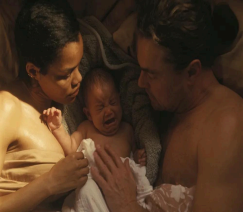
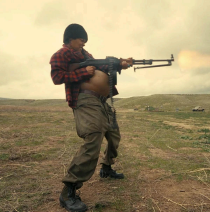
While on the run, her actions escalate into a bank hostage situation that leads to her arrest. From there, the story takes an even darker turn: Penn’s character “rescues” her, only to imprison her in a home where she is subjected to his control and sexual exploitation until she eventually escapes to Mexico.
The film then jumps forward in time. Penn kidnaps Perfidia’s now-grown child—who has been led to believe DiCaprio is her father—only to reveal that he himself is the biological parent. And while I’m skimming over several moments (including an especially cringeworthy scene where Penn interrogates DiCaprio about his attraction to Black women), the broader point stands: this film is less a thoughtful critique of immigration, racism, or institutional power and more a sex-obsessed extravaganza masquerading as social commentary.
So when we, as Black women, ask why Perfidia exists, we are not asking about the imagination of a single director—we are asking who exactly is meant to enjoy her.
Is it white women of suburbia who proudly cast their ballots for Hillary Clinton in the primaries?
Or is it the self-proclaimed left extremist who found Erica Kirk and Nicki Minaj’s exchange at Turning Point USA to be somehow revolutionary?
I digress, what lingers most is not the politics of this film—it is the industry’s appetite for domination, thinly veiled as diversity in the roles afforded to Black women. And that is precisely why I find that the only true escape from this voyeuristic consumption of so-called “critically acclaimed” films lies in the teachings of Africana Womanist Literary Theory, as articulated by Clenora Hudson-Weems. She posits Africana Womanism as the necessary “response to the need for collective definition and the re-creation of the authentic agenda that is the birthright of every living person.”
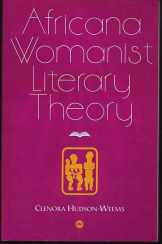
To move toward that authenticity, Hudson-Weems calls us back to the earliest foundations of African cultural history: an antiquity that reveals a shared ethos across the African world and affirms that Africana Womanism offers a relational framework fundamentally distinct from feminism. Because, truthfully, it is
often feminism; unyielding in its insistence on women’s placement at the helm of sociopolitical reform, regardless of the cost, that will rally behind films like this, even when that “progress” is dressed in degradation.
But Hudson-Weems understood something deeper: that the works of Zora Neale Hurston, most notably Their Eyes Were Watching God adapted for screen, once depicted relationships between Black men and women without subjecting them to the microscopic gaze of eroticized violence. It is also important to note that Halle Berry led the film as Janie Crawford and received no academy nomination.
What is absent in Perfidia is what Zora Neale Hurston’s lineage preserved: a vision of Black womanhood that is self-defined, spiritually grounded, and fully realized within the rhythms of the African diaspora. So before our tea gets cold, I’ll end it like this: Perfidia isn’t the villain here; she’s the evidence. And Miss Misogynoir? Oh, she got top billing!
And if we’re being intentional about where our dollars land, go ahead and pour into something sweeter: Halle Bailey (and yes, we love the Halles over here) alongside Regé-Jean Page in You, Me & Tuscany, in theaters April 10th.

.png)



.png)
